
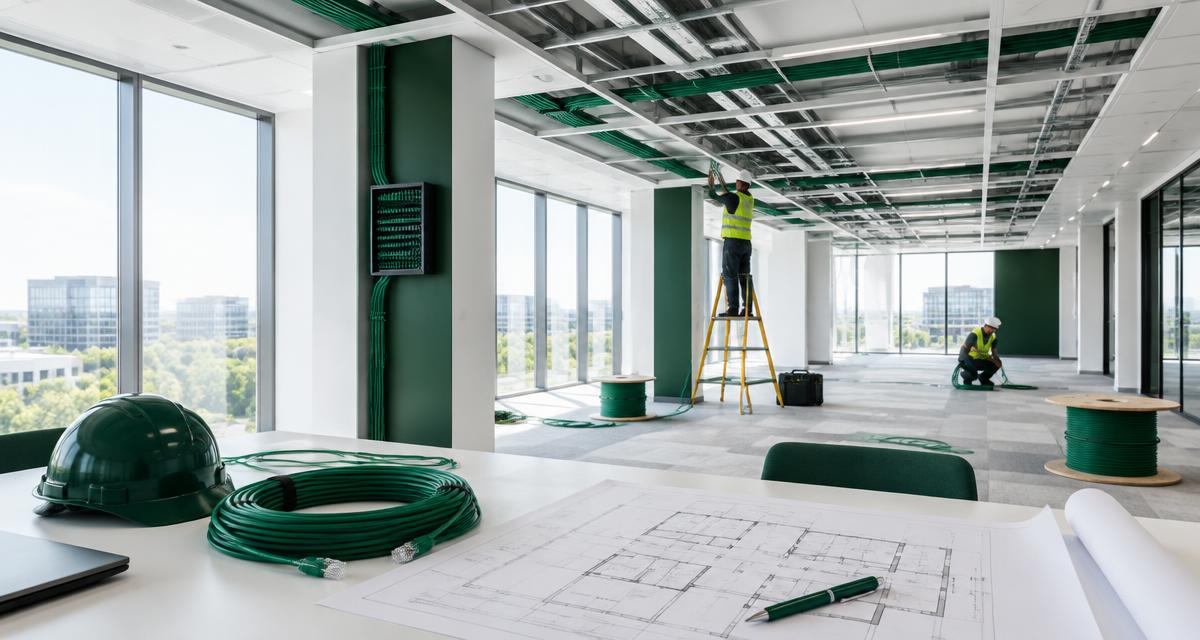
An office move is one of the few times a business can fix its network properly. Walls are open, ceilings are accessible and the cabling plan is still a drawing instead of a constraint. It is also the moment when small oversights become permanent problems.
Most move budgets cover furniture, rent and the removal truck. The network is often treated as something that can be sorted out in the final week. In practice, connectivity lead times, cabling routes and wireless design decide whether staff can work on day one.
Start with connectivity, not desks
Internet and voice services have the longest lead times in any move. Fibre wayleaves, building permissions and carrier installation windows can take months, especially in business parks and multi-tenant buildings. Confirm what exists in the building before signing the lease, and order services as soon as the address is final.
- Check the building, not the suburb: Fibre in the street does not mean fibre in your suite. Ask the landlord which providers are already in the building and where they enter.
- Plan a backup path early: A secondary LTE or fibre service is far cheaper to order upfront than to retrofit during an outage in the first month.
- Move numbers and services deliberately: Porting phone numbers, migrating firewalls and re-pointing public services all need scheduling. None of them happen automatically.
Cabling decisions outlive the furniture
Desks move every year. Cabling stays for a decade. The temptation is to cable exactly to the current floor plan, which guarantees patching chaos the first time a team expands. Cable to a sensible grid with spare capacity, and certify every run before the ceilings close.
- More points than desks: Include printers, wireless access points, cameras, access control, screens and a margin for growth. Adding a cable later costs many times more than adding it now.
- Certify before handover: A Fluke test report on every link is the only proof that the installation meets spec. Without it, every future fault becomes an argument about who is responsible.
- Label like someone else will maintain it: Consistent labelling at both ends, on the patch panel and in the floor plan turns a fault trace from hours into minutes.
Wireless needs a survey, not a guess
New offices are full of materials that fight wireless signals: glass partitions, concrete cores, metal ducting and dense open-plan seating. Mounting access points where the ceiling is convenient rather than where the coverage is needed produces dead zones and roaming problems that staff report as a slow network.
A predictive survey during design, followed by a validation survey once furniture is in, gives coverage that matches how the space is actually used. It also right-sizes the hardware count, which often saves money.
A realistic move sequence
- 1
Audit before you sign
Document existing services, contracts and equipment. Confirm building connectivity options and landlord requirements for cabling routes.
- 2
Design while the walls are open
Finalise the cabling plan, cabinet location, power and cooling, wireless survey and security camera points with the fit-out team, not after them.
- 3
Install and certify early
Complete cabling, certification, switching and wireless before the moving weekend. Test internet, failover, WiFi roaming and printing with real users.
- 4
Decommission the old site properly
Cancel services in writing, recover equipment, wipe devices and confirm final billing. Forgotten circuits keep invoicing for months.
The move is the opportunity
A well-run move leaves the business with certified cabling, measured wireless coverage, documented services and a network that supports growth instead of resisting it. The cost difference between doing it once and doing it twice is decided in the planning, not the installation.
2bo plans and delivers office move networks across South Africa, from connectivity orders and structured cabling to wireless surveys and day-one support. One accountable team, from the first site visit to the last label.
Planning an office move?
2bo can audit the new site, order connectivity, design and certify the cabling, survey the wireless and support your team on day one.